

AI Is Accelerating Code Generation. But Is It Accelerating Software Engineering?


Why the real challenge in AI-assisted development is shifting from writing code to establishing correctness.
AI coding agents are becoming remarkably capable. They can understand existing codebases, generate APIs, implement business logic, write unit tests, refactor applications, and even diagnose their own failures. What once took hours can sometimes be implemented in minutes. This is a significant shift in how we develop software.
But there is a question I keep coming back to: Are we actually delivering better software, or are we simply generating more code, faster?
I believe there is a fundamental difference between accelerating code generation and accelerating software engineering. And as AI coding agents become more capable, that difference will matter even more.
The Hidden Problem: Correct Code, Wrong Outcome
Consider a payment-processing platform. A requirement is given to an AI coding agent: "Implement retry handling when the payment provider times out."
The agent generates a clean implementation using Spring Boot, Resilience4j, and exponential backoff.
The code compiles. Unit tests pass. The implementation follows established retry patterns.
At first glance, everything looks correct.
But consider this failure scenario.
The payment provider successfully processes a payment.
The response is lost because of a network timeout.
Our application assumes the payment failed.
The retry mechanism submits the same payment again.
The customer is charged twice if the provider does not enforce idempotency.
The implementation may be technically sound, yet the outcome is unacceptable. The problem was not necessarily the quality of the generated code.
The problem was an incomplete understanding of the system's behavioral guarantees.
A retry is not simply a technical mechanism. In a distributed system, it is a business decision with consistency and correctness implications. Before implementing retries, we should understand whether an operation is idempotent, how uncertain outcomes are reconciled, and what guarantees the downstream system provides. These decisions cannot be safely delegated as unspecified assumptions.
We Need to Shift from Instructions to Engineering Invariants
I think one of the biggest opportunities in AI-assisted development is changing how we describe engineering problems.
Today, many prompts are implementation-oriented:
Create a REST API.
Implement a caching layer.
Add retry logic.
Build an event consumer.
Optimize the database query.
These describe activities. But they do not necessarily define the properties the system must preserve.
For example, instead of simply requesting retry handling, we might define the following invariants:
Invariant 1: A retry must not create a duplicate business effect.
Invariant 2: A timeout must not automatically be interpreted as a failed transaction.
Invariant 3: An uncertain payment outcome must be reconciled before an unsafe retry.
Invariant 4: Every payment attempt must remain traceable across internal and external systems.
These are not implementation instructions. They describe what must remain true regardless of whether the implementation uses synchronous APIs, asynchronous messaging, a state machine, or a workflow engine. This is an important distinction.
Architecture is not just about choosing components. It is about defining the properties a system must preserve, especially when things fail.
AI coding agents should be allowed to explore implementation options within those boundaries. But the boundaries themselves need explicit engineering ownership.
From Intent to Verified Delivery
I see five responsibilities becoming increasingly important in AI-assisted software engineering.
Intent → Invariants → Implementation → Evidence → Evolution
These are not necessarily five sequential development phases. They represent five connected responsibilities that should influence the entire engineering process.
1. Intent: Understand the Real Problem
Before generating code, we need to establish the intended business outcome.
What are we trying to achieve?
Who depends on the behavior?
What assumptions are we making?
Which existing capabilities must remain unchanged?
An AI agent can help investigate the codebase, surface ambiguities, and challenge incomplete requirements. But it should not silently turn unknown business decisions into implementation assumptions. For complex systems, a few well-placed questions before implementation can prevent substantial rework later.
2. Invariants: Define What Must Never Break
Functional requirements explain what a system should do. Invariants describe properties that must remain true across successful operations, failures, retries, concurrency, and recovery.
In a payment platform, these may concern duplicate business effects and reconciliation.
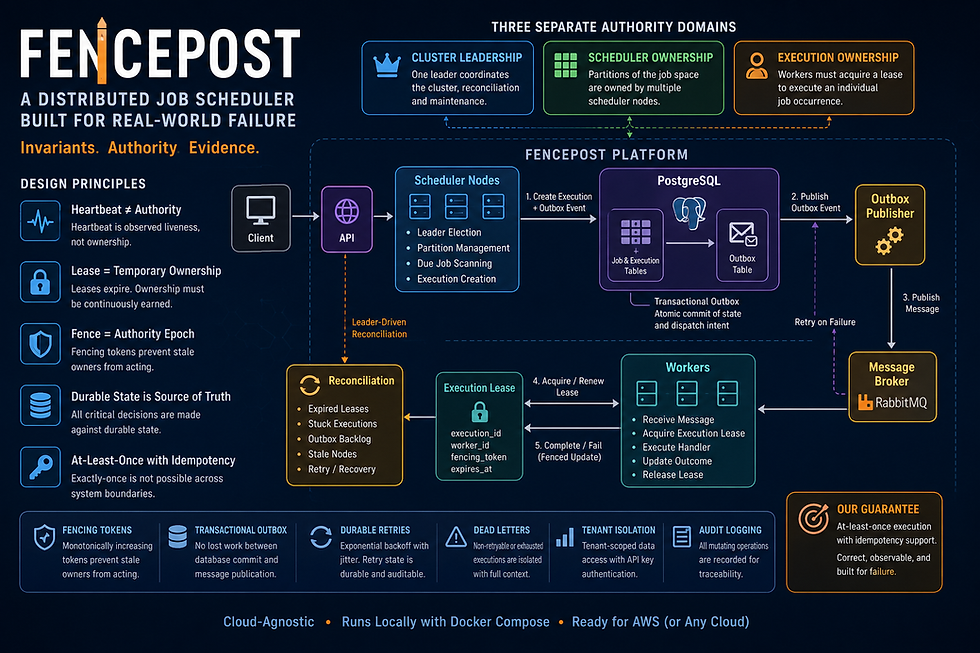
In a distributed scheduler, they may involve lease ownership, fencing tokens, and idempotency. In a credit-risk platform, they may involve authorisation boundaries, hierarchy constraints, and transactional consistency. These properties provide a more stable foundation for implementation than detailed instructions alone.
A coding agent can change algorithms, refactor classes, or reorganize components.
But it must continue to satisfy the agreed invariants.
3. Implementation: Let AI Accelerate the Engineering Work
Once intent and invariants are clear, AI agents can contribute significant value.
They can research existing code, propose a design, implement changes, generate tests, and diagnose failures. The objective should not be to prescribe every line of code. It should be to give the agent enough context and boundaries to make useful implementation decisions. This changes the engineer's role from controlling every coding step to reviewing important design decisions and ensuring the implementation remains aligned with the system's intended behavior. However, autonomy should be proportional to risk. A low-impact internal utility and a payment-processing workflow should not have identical approval and validation requirements.
4. Evidence: Prove the Behavior, Not Just the Build
This is where I believe engineering teams need to invest more attention.
A successful build is evidence that code compiled. Passing unit tests is evidence that the implementation satisfied the assertions those tests contain. Neither automatically proves that the complete system behaves correctly under production-like conditions.
Take the payment timeout scenario again.
A meaningful validation strategy should test what happens when the provider processes a transaction but its response never reaches our application.
Can the system identify the uncertain outcome?
Does it reuse a stable idempotency key where supported?
Can it reconcile the transaction before retrying?
Does the final state remain consistent across the application and payment provider?
These are behavioral questions, not merely code-quality questions. To answer them, AI coding agents need access to controlled validation capabilities: API test runners, database assertions, message-broker inspection, fault injection, and observability.
I would go one step further.
The agent can execute validation, but the evidence of correctness should come from independently verifiable checks.
An agent declaring that its own implementation works should not be the final acceptance mechanism for a critical system.
5. Evolution: Improve the Engineering System, Not Only the Code
Suppose an AI coding agent introduces an unsafe retry. The immediate response is to correct the implementation and add a regression test.
But I think we should ask another question:
Why did our engineering process allow this failure to escape?
Perhaps the original requirement did not mention idempotency. Perhaps the agent lacked the necessary domain context. Perhaps the test suite covered only successful retries. Or perhaps the validation environment could not simulate a lost response after a successful downstream operation.
Depending on the root cause, we might improve a contract, architectural guideline, reusable agent skill, automated test, or validation harness. This is where long-term value can accumulate. Instead of repeatedly solving the same class of problems, engineering teams develop reusable knowledge and verification capabilities.
But I would avoid automatically adding a new agent rule after every defect. Too many overlapping instructions can become difficult to maintain and may introduce conflicting behaviour. The improvement itself should be reviewed and tested.
Validation Capabilities Are Becoming an Architectural Concern
Traditionally, developer productivity platforms have focused on build pipelines, source control, dependency management, environments, and observability. With AI coding agents, I think another capability becomes increasingly important:
Making application correctness observable and testable by automated engineering tools.
Imagine a reusable validation platform that can:
Execute approved behavioral scenarios.
Start isolated application environments.
Introduce controlled dependency failures.
Inspect database and message states.
Correlate test outcomes with logs and distributed traces.
Produce structured evidence linked to engineering requirements.
The goal is not to let an LLM decide whether a system is correct.
It is to let an agent invoke reliable validation mechanisms that already know how to evaluate the required behavior. This separation matters. The agent provides reasoning and implementation flexibility. The validation infrastructure provides controlled execution, objective assertions, and reproducible evidence. For enterprise systems, these responsibilities should not be blurred.
AI Engineering Should Become a Platform Capability
I don't think every development team should independently build its own collection of prompts, agent instructions, testing procedures, and tool integrations. That would create duplication and inconsistent engineering quality. At the same time, I don't believe one centralized AI platform should define every domain's correctness criteria.
The right balance may be a shared engineering foundation with domain-owned rules and validation.
Platform teams could provide reusable capabilities such as validation tooling, secure agent access, evidence collection, and approved engineering workflows.
Domain teams would continue to own business invariants, architectural decisions, and acceptance criteria.
For example, a shared validation platform could provide controlled fault injection.
A payment team would use it to test uncertain transaction outcomes.
A scheduler team would use it to test stale-worker execution.
A credit-risk team would use it to test transactional failures and concurrent updates.
The infrastructure is reusable.
The correctness criteria remain domain-specific. This is the kind of platform abstraction I find valuable: one that reduces repeated engineering effort without hiding important business semantics.
Are We Measuring the Right Productivity?
AI coding tools are often evaluated by how quickly they generate code, how many tasks they complete, or how much developer activity they automate.
Those measurements have value, but they are incomplete.
A feature implemented in 20 minutes is not necessarily a productivity improvement if engineers spend several hours correcting misunderstood requirements or investigating defects.
I would rather evaluate AI-assisted engineering using outcomes such as:
How frequently implementations satisfy agreed acceptance criteria without substantial rework.
How much engineering effort is spent correcting generated changes.
Whether critical invariants are covered by executable validation.
Whether defects escape into later testing stages or production.
Whether recurring classes of failures become less common.
Whether the total time from requirement to verified delivery actually improves.
These measurements bring the discussion back to software delivery rather than code generation. And they make it possible to evaluate AI engineering practices with evidence instead of enthusiasm.
My Perspective: Engineering Judgment Becomes More Important, Not Less
I don't believe AI coding agents will make software architecture irrelevant. I think they will expose the difference between knowing how to implement something and understanding what must be implemented. Writing a retry mechanism is relatively straightforward.
Understanding when retrying is safe is much harder. Generating a distributed scheduler is increasingly achievable. Establishing its execution guarantees during network partitions, lease expiry, crashes, and duplicate delivery remains a difficult engineering problem.
Creating an API is easy. Defining the domain boundaries, consistency requirements, and failure semantics behind that API requires judgment.
As AI takes on more implementation work, experienced engineers should spend more time defining invariants, challenging assumptions, designing failure scenarios, and establishing trustworthy validation.
Not every application needs an elaborate validation platform. But every critical system needs a clear understanding of what correctness means and how that correctness can be demonstrated.
For me, that is the direction AI-assisted engineering needs to evolve.
The future of software engineering will not be defined only by how much code AI can generate. It will also be defined by how confidently we can turn that code into reliable, verifiable systems.
And that is a responsibility engineering teams cannot afford to delegate blindly.


Comments