

Beyond Code Generation: What I Learned Using Kiro in Enterprise Development

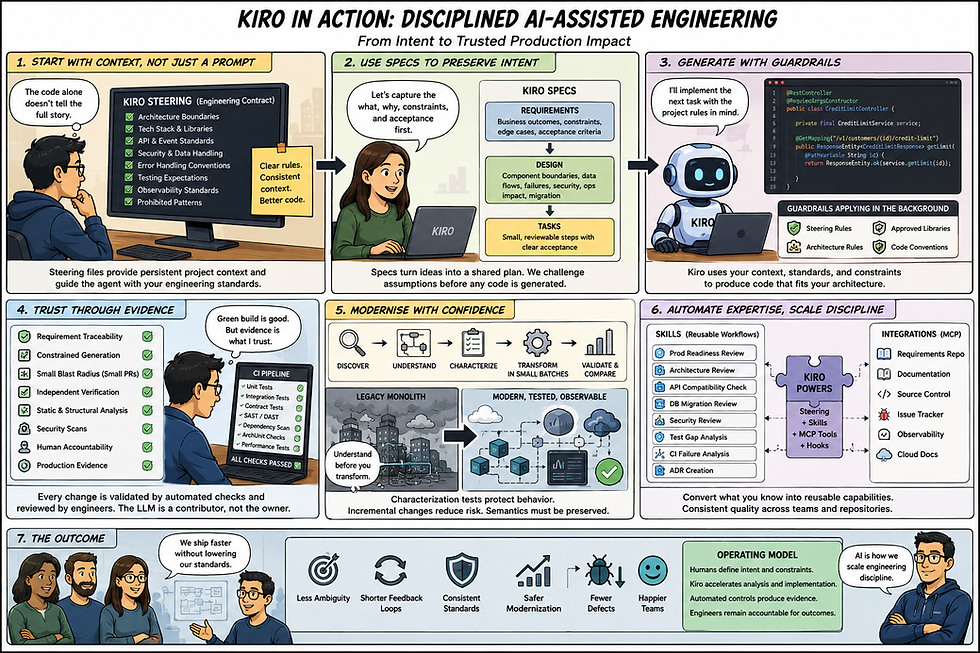
When I started using Kiro, the initial value was obvious. It could generate Spring Boot classes, create unit tests, explain unfamiliar code, and suggest fixes for build failures. The speed was useful, but it also exposed a more important question:
How do we trust AI-generated code in an enterprise system?
As a Principal Engineer supporting multiple delivery teams, I am responsible not only for whether code works, but also for whether it remains secure, maintainable, observable, resilient, and aligned with the platform’s long-term architecture.
That changed how I used Kiro. I stopped treating it as a code generator and started treating it as part of the engineering system.
The first problem was missing context
In one typical Java modernization task, the implementation looked technically correct. The generated code compiled, followed common Spring Boot conventions, and included tests. However, it did not fully reflect the operational standards expected in our environment.
The outbound integration needed explicit connection and response timeouts, controlled retries, structured error handling, and metrics. None of these requirements were visible from the individual class being modified.
This is common in enterprise systems. Source code rarely contains the complete engineering context. Important decisions are spread across architecture documents, API standards, security policies, production incidents, runbooks, and team conventions.
I began using Kiro Steering files as a concise engineering contract for the repository. They captured rules such as:
Controllers must not access repositories directly.
Outbound calls require explicit timeouts.
Retries must be limited and safe.
Public API changes require compatibility analysis.
Sensitive data must never be written to logs.
Critical business flows require metrics and traceability.
Database changes must support controlled deployment and rollback.
The improvement was not simply better code generation. The team spent less time repeating the same expectations during reviews, and architectural issues were identified earlier.
However, Steering must remain focused. It should not become a copy of every design document. Long explanations belong in ADRs and architecture documents. Steering should contain the decisions that Kiro must consistently follow.
Specs helped us challenge assumptions before code existed
The second important change was using Kiro Specs for meaningful features rather than immediately requesting implementation.
Consider a credit-limit API that combines information from more than one source. A simple prompt could generate a controller, service, repository, DTOs, and tests. The result might appear complete while leaving critical questions unanswered:
Which system is authoritative?
Is the response strongly consistent or eventually consistent?
What happens when one dependency is unavailable?
Can the request be retried safely?
Is the result auditable?
What latency is acceptable?
How will existing API consumers be protected?
What is the rollback strategy?
These are not coding questions. They are system-design questions.
Using a Spec allowed the team to review requirements, design, and implementation tasks before generating significant amounts of code. We could challenge failure handling, transaction boundaries, security, compatibility, observability, and deployment assumptions while changes were still inexpensive.
The most important lesson was that AI can implement an incorrect assumption extremely well. A clear Spec reduces that risk by making the assumption visible before it becomes code.
Trust must come from evidence
I do not automatically trust code because Kiro generated it, and I do not reject it for the same reason. The author may be different, but the engineering controls should remain rigorous.
I use a risk-based validation model.
Change risk | Examples | Minimum evidence |
Low | Boilerplate, formatting, test data, documentation | Compilation, focused tests, human review |
Medium | API implementation, refactoring, integration changes | Unit, integration and contract tests, static analysis, architecture checks |
High | Financial calculations, authorization, concurrency, schema migration | Independent test design, specialist review, rollback plan, canary or controlled release |
Several controls are particularly important.
Traceability
Every generated change should map to an approved requirement, defect, design decision, or migration task. The agent should not introduce unrelated functionality or unnecessary dependencies.
Small blast radius
I prefer Kiro to implement one small task at a time. Smaller changes are easier to understand, verify, review, and reverse.
Independent verification
The implementation and its tests should not be accepted as a single unit of evidence. An LLM may generate a test that confirms the same misunderstanding present in the implementation.
For critical behaviour, test scenarios should come from independent sources such as API contracts, business rules, production examples, golden datasets, or existing system behaviour.
Structural and security controls
Compilation and unit tests cannot detect every problem. We also need:
Static analysis
Dependency and vulnerability scanning
Secret detection
Architecture tests
API compatibility checks
Database migration validation
Performance testing where required
In Java applications, ArchUnit is useful for converting architecture rules into executable controls. For example, it can prevent controllers from accessing repositories or stop domain packages from depending on infrastructure code.
AI-specific checks
Generated code introduces several risks that deserve explicit review:
Hallucinated libraries, APIs, methods, or configuration properties
Dependencies that do not match the approved version
Hidden changes to transaction boundaries
Different retry or timeout semantics
Serialization incompatibilities
Altered null-handling or ordering behaviour
Outdated Steering instructions
Excessive permissions through external tools
A green pipeline is useful evidence, but it is not proof of correctness.
Modernization requires semantic preservation
Kiro is valuable in modernization because much of the work is repetitive and context-heavy. It can help identify deprecated APIs, field injection, old logging frameworks, blocking clients, duplicated validation, inconsistent error handling, and unsupported Java constructs.
But asking an agent to “modernize the application” in one large step is risky.
I use a controlled sequence:
Map the existing modules, dependencies, integrations, data access, runtime behaviour, and test coverage.
Create characterization tests around important legacy behaviour.
Define the target architecture and migration rules through Steering and Specs.
Apply transformations in small batches.
Compile, test, review, and compare behaviour after every batch.
Migration success cannot be measured only by compilation or test pass rate. We must preserve the system’s semantics:
API contracts
Event schemas
Transaction guarantees
Error codes
Data consistency
Ordering behaviour
Performance characteristics
Auditability
Operational procedures
For example, replacing a synchronous interaction with asynchronous messaging may appear architecturally modern, but it changes consistency, failure recovery, and customer-visible behaviour. Kiro can generate the implementation, but engineers must decide whether those semantic changes are acceptable.
This approach is useful for Java and Spring upgrades, cloud migration, containerization, API standardization, database separation, CI/CD modernization, and monolith decomposition.
Kiro reduces mechanical effort. It does not make domain boundaries, data ownership, transaction strategy, release sequencing, or production risk disappear.
Automation turned repeated reviews into reusable capability
The biggest improvement came when we stopped repeating the same prompts and converted recurring engineering knowledge into reusable Skills, Hooks, and automated checks.
Common workflows included:
Production-readiness review
API compatibility review
Architecture review
Database migration review
Test-gap analysis
CI failure investigation
ADR creation
Hooks can automatically run formatting, focused tests, static analysis, security scans, or architecture checks after relevant changes. Skills can apply a consistent review process across different repositories and teams.
This is where AI-assisted development becomes organizational learning. When a recurring production issue or review finding becomes a Steering rule, Skill, Hook, or executable test, the engineering system becomes less likely to repeat the same mistake.
External integrations through MCP or similar mechanisms also require governance. In regulated environments, access should be read-only by default, limited by least privilege, auditable, and approved for the information being accessed.
The leadership lesson
The success of Kiro should not be measured by the number of generated lines of code.
The better measures are whether it reduces ambiguity, shortens feedback loops, improves consistency, accelerates safe modernization, reduces repetitive review work, and makes engineering standards executable.
My operating model is now simple:
Engineers define intent, constraints, semantics, and acceptable risk. Kiro accelerates analysis and implementation. Automated controls produce evidence. Humans remain accountable for production outcomes.
Used this way, Kiro is not a shortcut around engineering discipline. It is a practical mechanism for scaling that discipline across teams, repositories, and modernization programmes.


Comments